
Best Laptop for AI and ML Programming in Nepal Under NPR 1,50,000 in 2026

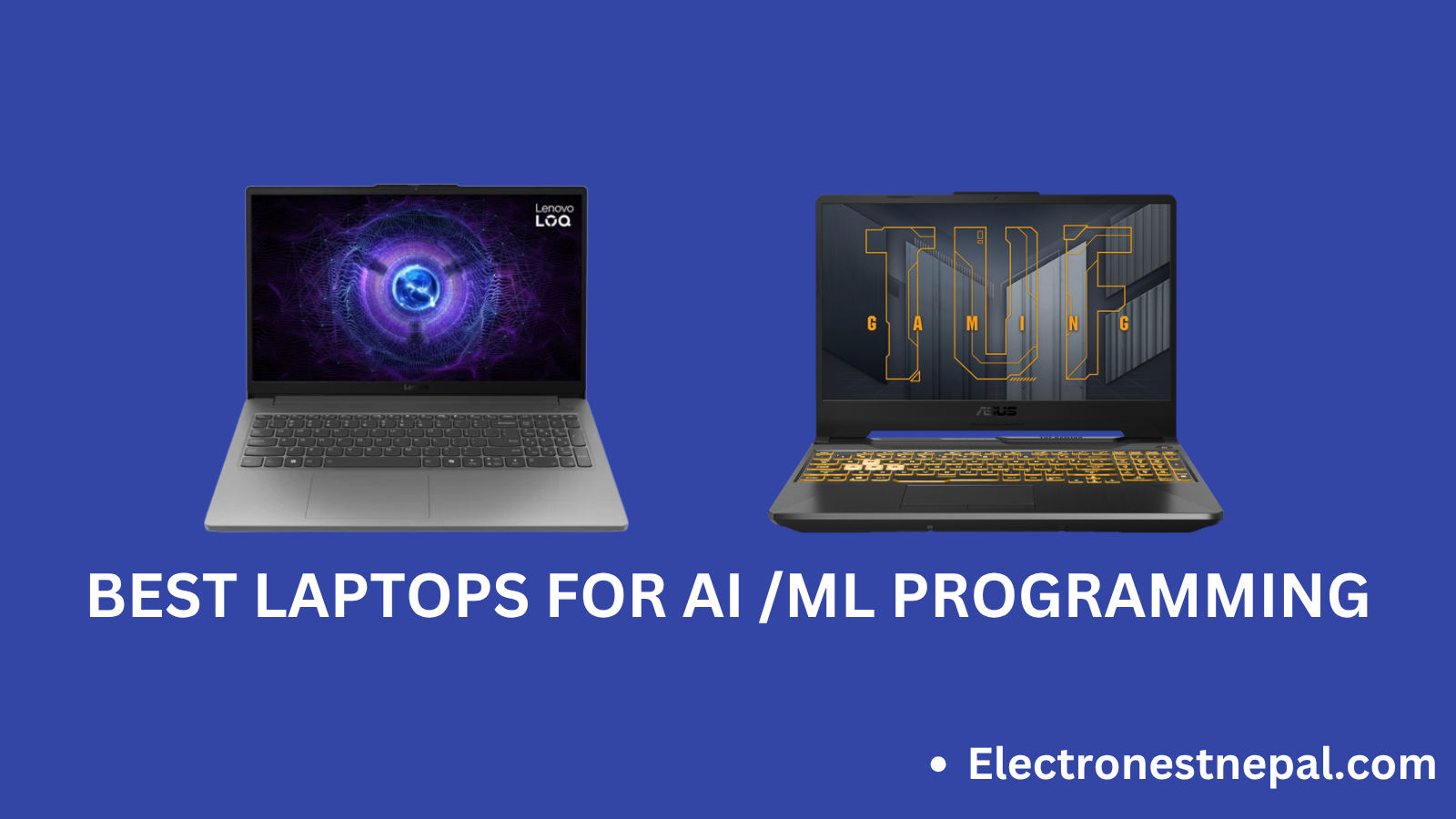
TL;DR: The best laptops for AI and machine learning programming in Nepal under NPR 1,50,000 in 2026 are the Lenovo LOQ 15 (RTX 4050, 16GB RAM) at NPR 1,20,000 to 1,30,000 and the ASUS TUF Gaming A16 (RTX 4050, 16GB RAM) at NPR 1,22,000 to 1,46,499. Both give you the NVIDIA CUDA cores required to run TensorFlow, PyTorch, and scikit-learn with hardware acceleration, strong multicore CPUs for data processing, and expandable RAM for growing workloads. If you are studying data science, doing ML coursework at TU, PU, or KUSOM, or working as a junior ML engineer in Nepal, either laptop gives you a real workstation foundation under this budget.
Quick Verdict Box
- Best overall AI/ML laptop under NPR 1,50,000 in Nepal: Lenovo LOQ 15 (Ryzen 5 7235HS, RTX 4050 6GB, 16GB RAM) at NPR 1,20,000 to 1,30,000
- Best build quality for long-term use: ASUS TUF Gaming A16 (Ryzen 7 7445HS, RTX 4050 6GB, 16GB RAM) at NPR 1,22,000 to 1,46,499
- Best CPU performance for training workloads: Lenovo LOQ 15 with Intel Core i7-13650HX variant at NPR 1,40,000 to 1,50,000
- Best display for coding long hours: ASUS TUF A16 (16-inch, 1920×1200 IPS, 100% sRGB)
- Minimum RAM for AI/ML in 2026: 16GB. Do not buy an 8GB laptop for ML work.
- Where to buy genuine with warranty: Electronest Nepal
Who This Page Is For
You are a student, junior developer, or working professional in Nepal who needs a laptop specifically for AI and machine learning work. You are running Python environments, Jupyter notebooks, TensorFlow, PyTorch, or scikit-learn. Your budget is NPR 1,50,000 or below and you want the best laptop available in Nepal at that price for this specific use case.
This page is for you if:
- You are studying data science, computer science, or AI engineering at a Nepal university (TU, PU, KU, KUSOM, Herald)
- You are working as a junior data scientist, ML engineer, or Python developer in Nepal
- You want NVIDIA CUDA GPU acceleration for model training without paying above NPR 1,50,000
- You need a laptop that handles large datasets, virtual environments, Docker containers, and multiple IDE windows simultaneously
This page is NOT for you if:
- Your ML work involves training large transformer models from scratch (LLMs, diffusion models). Those require workstation GPUs starting at RTX 4080 tier or above, and a cloud GPU instance on AWS or Google Colab is more practical at that scale regardless of budget.
- You only need a laptop for web development or basic Python scripting. Any decent laptop with 16GB RAM works for that. Read our Best Laptops for IT Students in Nepal 2026 instead.
- Your budget is above NPR 1,50,000. RTX 4060 laptops deliver significantly more CUDA performance for training and are worth pursuing if you can stretch.
Why AI and ML Work Has Different Laptop Requirements Than Regular Programming
Most laptop buying guides lump all programming together. AI and ML work has fundamentally different hardware needs that separate it from web development, app development, and general coding.
NVIDIA CUDA is non-negotiable for local ML training. PyTorch and TensorFlow both use CUDA for GPU acceleration. CUDA is NVIDIA-proprietary. This means AMD Radeon GPUs and Intel Arc GPUs do not accelerate ML training natively in 2026 without workarounds. If your laptop has no NVIDIA GPU, every model training job runs on the CPU only, which is 10 to 50 times slower depending on the model size.
VRAM matters more than gaming performance. For ML work, the GPU’s VRAM (video memory) determines the maximum batch size you can train with. The RTX 4050 in most Nepal laptops under NPR 1,50,000 has 6GB VRAM. This is adequate for computer vision models (CNN, ResNet, EfficientNet), NLP fine-tuning (BERT, DistilBERT, small GPT-2 variants), and standard tabular ML. It is not sufficient for training large language models or fine-tuning models above 7 billion parameters locally.
RAM is the other bottleneck. Data loading, preprocessing, and keeping multiple Jupyter notebooks open simultaneously consumes RAM fast. 16GB is the minimum for AI/ML work in 2026. 32GB is better for working with large CSV datasets, pandas DataFrames over 2GB, or running multiple virtual environments simultaneously. Most laptops under NPR 1,50,000 ship with 16GB but have upgrade slots for 32GB later.
CPU multicore performance for data processing. Pandas, NumPy, and scikit-learn operations are CPU-bound. A laptop with a high-performance H-series processor (Intel HX/H or AMD HS series) processes data transformations, feature engineering, and CPU-based model training significantly faster than a U-series ultrabook processor. Always check that the CPU is an H or HX/HS series, not a U-series.
Minimum Spec Requirements for AI/ML Programming in Nepal
Before looking at specific models, here is the minimum hardware standard for AI/ML work in 2026:
| Component | Minimum for AI/ML | Recommended |
|---|---|---|
| CPU | Intel Core i5-H / AMD Ryzen 5 HS (8+ cores) | Intel Core i7-HX / AMD Ryzen 7 HS |
| RAM | 16GB DDR5 (upgradeable) | 32GB DDR5 |
| GPU | NVIDIA RTX 2050 4GB VRAM (CUDA 12.x) | NVIDIA RTX 4050 6GB VRAM |
| Storage | 512GB NVMe SSD | 1TB NVMe SSD |
| Display | 15.6-inch FHD IPS | 16-inch FHD+ IPS, 100% sRGB |
| Battery | 60Wh (4 to 5 hours coding) | 80Wh (6 to 7 hours) |
Any laptop that does not have an NVIDIA GPU is not recommended for local ML model training. Use Google Colab (free tier) or Kaggle Notebooks for GPU compute instead.
Best Laptops for AI/ML Programming in Nepal Under NPR 1,50,000 in 2026
1. Lenovo LOQ 15 (RTX 4050, 16GB RAM): Best Overall AI/ML Laptop Under 1,50,000 in Nepal
Price: NPR 1,20,000 to 1,30,000
The Lenovo LOQ 15 with AMD Ryzen 5 7235HS or Intel Core i5-13450HX, RTX 4050 6GB VRAM, and 16GB DDR5 RAM is the best laptop for AI and ML programming in Nepal under NPR 1,50,000. Here is why this specific combination works for ML workloads:
The RTX 4050 includes 2,560 CUDA cores running CUDA 12.x, which is fully supported by the current PyTorch 2.x and TensorFlow 2.x frameworks available in 2026. Training a standard ResNet-50 image classification model on a dataset of 50,000 images takes approximately 8 to 12 minutes per epoch on the RTX 4050. The same job on integrated graphics or a CPU-only setup takes 90 to 180 minutes per epoch.
The 100% sRGB IPS display at 144Hz is easy on the eyes during long coding sessions. The LOQ 15 runs at up to 105W TGP for the RTX 4050, which is higher than many competing laptops that throttle the same GPU to 60 to 75W. Higher TGP means faster sustained training performance.
RAM is upgradeable to 32GB via the two DDR5 slots. The 512GB SSD is adequate for most project work but an upgrade to 1TB is affordable in Nepal at approximately NPR 4,500 to 7,000 for a PCIe Gen 4 M.2 drive.
The Lenovo LOQ is widely used by engineering students, IT professionals, and content creators in Nepal and supports demanding software including MATLAB, Unreal Engine, and AI frameworks like TensorFlow and PyTorch.
Best for: Data science students, ML engineering coursework, Python developers running TensorFlow and PyTorch locally, anyone doing computer vision or NLP fine-tuning projects.
Weakness: Battery life at 5 to 6 hours under light load drops to 1.5 to 2 hours during active GPU training. Always bring your charger to campus or the office.
Available at Electronest Nepal: Yes, with official warranty and free Kathmandu Valley delivery.
2. ASUS TUF Gaming A16 (RTX 4050, 16GB RAM): Best Build Quality for Long-Term AI/ML Use
Price: NPR 1,22,000 to 1,46,499
The ASUS TUF laptop price in Nepal ranges from NPR 1,20,900 to NPR 2,79,900, and the A16 configuration with RTX 4050 sits right at the NPR 1,22,000 to 1,46,499 range depending on the specific variant. For AI/ML programmers in Nepal, the TUF A16 brings three meaningful advantages over the LOQ 15.
First, the 16-inch 1920×1200 (WUXGA) IPS display with a 16:10 aspect ratio gives you noticeably more vertical screen space than the LOQ 15’s standard 16:9 panel. For reading documentation, comparing Jupyter notebook cells side by side, and long coding sessions, the extra vertical pixels matter practically every day.
Second, ASUS TUF laptops meet MIL-STD-810H military durability standards. For students and professionals who carry their laptops daily across Kathmandu, Pokhara, or to client sites, this build resilience translates to a longer laptop lifespan.
Third, the ASUS TUF A16 comes with a 2-year ASUS international warranty plus 1-year ASUS Perfect warranty in Nepal. This is a stronger warranty package than the 1-year standard on the Lenovo LOQ 15.
The RTX 4050 6GB GPU on the TUF A16 performs comparably to the LOQ 15’s RTX 4050 for CUDA workloads. Both deliver the same CUDA core count and VRAM. The difference is build quality, display size, and warranty, not raw ML training speed.
Best for: ML students and professionals who carry their laptop daily, anyone prioritizing long-term durability and a larger 16:10 display for productive coding.
Weakness: Heavier than the LOQ 15 at approximately 2.2kg. Not the most portable option if you travel light.
Available at Electronest Nepal: Yes, with official warranty and free Kathmandu Valley delivery.
3. Lenovo LOQ 15 (Intel Core i7-13650HX, RTX 4050): Best CPU Performance Under 1,50,000
Price: NPR 1,40,000 to 1,50,000
The Intel Core i7-13650HX variant of the Lenovo LOQ 15 offers the strongest CPU performance available under NPR 1,50,000 in Nepal for AI/ML work. The i7-13650HX has 14 cores (6 performance cores plus 8 efficiency cores) with a boost clock of 4.9 GHz. For CPU-bound ML operations like pandas data manipulation, scikit-learn model training, and multiprocessed data loaders in PyTorch, this processor outperforms the Ryzen 5 7235HS by 25 to 35 percent in sustained multicore workloads.
If your ML work involves heavy data preprocessing on large tabular datasets, frequent scikit-learn model training and hyperparameter tuning, or running Docker containers for MLOps workflows, the i7-13650HX variant is the better choice at the NPR 1,40,000 to 1,50,000 price point.
Best for: Data scientists doing heavy tabular ML work, MLOps learners running Docker, students whose coursework involves large dataset preprocessing.
Weakness: Higher price leaves less budget for external peripherals, SSD upgrades, or cooling pads.
4. HP Victus 15 (RTX 4050, 16GB RAM): Best Alternative Under 1,50,000
Price: NPR 1,19,999 to 1,30,000
The HP Victus 15 with AMD Ryzen 7 7445HS and NVIDIA RTX 4050 6GB is a strong alternative to the LOQ 15 for AI/ML programming in Nepal. The Lenovo LOQ 15 has a Ryzen 5 7235HS processor and NVIDIA RTX 4050 graphics, making it great for both performance and price, while the HP Victus 15 offers an affordable way to play AAA games, thanks to its RTX 3050 6GB graphics and Intel Core i5 processor. However, higher-end Victus configurations with RTX 4050 are available in Nepal.
The Victus 15 carries a large 83Wh battery, which is the biggest battery in this comparison. For ML students who work on campus or in cafes where power outlets are limited, the Victus 15’s battery advantage is real. It delivers 5 to 7 hours of coding with light GPU use, and 2 to 3 hours during active training sessions. HP also has a strong service center network in Nepal.
Best for: Students who need the best battery life in this segment, buyers who prefer HP’s service network over Lenovo or ASUS.
Weakness: The Victus 15’s display covers approximately 72% NTSC, which is lower colour accuracy than the LOQ 15 or TUF A16. For data visualization and working with image datasets, colour accuracy matters.
Head-to-Head Comparison: AI/ML Laptops Under NPR 1,50,000 in Nepal
| Factor | Lenovo LOQ 15 (R5 + RTX 4050) | ASUS TUF A16 (R7 + RTX 4050) | HP Victus 15 (R7 + RTX 4050) |
|---|---|---|---|
| Price Nepal | NPR 1,20,000 to 1,30,000 | NPR 1,22,000 to 1,46,499 | NPR 1,19,999 to 1,30,000 |
| GPU | RTX 4050 6GB, 2560 CUDA cores | RTX 4050 6GB, 2560 CUDA cores | RTX 4050 6GB, 2560 CUDA cores |
| CPU | Ryzen 5 7235HS or i5-13450HX | Ryzen 7 7445HS | Ryzen 7 7445HS |
| RAM | 16GB DDR5 (2 slots) | 16GB DDR5 (2 slots) | 16GB DDR5 |
| Display | 15.6″ FHD 100% sRGB 144Hz | 16″ FHD+ 100% sRGB 144Hz | 15.6″ FHD ~72% NTSC 144Hz |
| Battery | 60Wh | 72Wh | 83Wh |
| Weight | 2.38kg | 2.2kg | 2.29kg |
| Build rating | Standard plastic build | MIL-STD-810H | Standard plastic build |
| Warranty Nepal | 1 year | 2 years international | 1 year |
| Best ML use case | General AI/ML, best value | Daily carry + ML, best display | Best battery for campus use |
What Frameworks and Tools Run Well on These Laptops in Nepal
Here is a practical breakdown of what you can run on an RTX 4050 laptop under NPR 1,50,000 in Nepal:
Runs well with CUDA acceleration:
- PyTorch 2.x and TensorFlow 2.x (GPU mode enabled via CUDA 12.x)
- Jupyter Lab and Jupyter Notebook (multi-kernel, no slowdown)
- Scikit-learn, XGBoost, LightGBM, CatBoost (CPU-bound, benefits from multicore CPU)
- OpenCV for computer vision data pipelines
- Hugging Face Transformers for fine-tuning smaller BERT and DistilBERT models
- YOLO v8 and v9 object detection training on custom datasets
- Stable Diffusion inference (SDXL-Turbo runs comfortably at 6GB VRAM)
- VS Code, PyCharm Professional, Anaconda Navigator
- Docker Desktop for containerized ML workflows
- DVC (Data Version Control) for experiment tracking
Runs with limitations (6GB VRAM ceiling):
- Fine-tuning Llama 2 7B or Mistral 7B models (requires 4-bit quantization via bitsandbytes)
- Stable Diffusion XL full resolution (works but slower than 8GB VRAM cards)
- Training on video datasets above 720p (consider using Google Colab for these)
Not suitable for locally:
- Training GPT-2 medium or larger from scratch
- Running multiple large model inferences simultaneously
- Training on 4K video datasets
For workloads beyond the 6GB VRAM ceiling, Google Colab Pro (approximately USD 10/month), Kaggle GPU notebooks (free 30 hours/week), or AWS SageMaker remain practical complements to local development in Nepal.
The CPU Question: AMD Ryzen vs Intel Core for AI/ML in Nepal Under 1,50,000
Both AMD and Intel perform well for ML work in this price range. Here is the practical difference for Nepal buyers:
AMD Ryzen 7 7445HS (ASUS TUF A16, HP Victus): 8 cores, 16 threads, 4.7 GHz boost. Excellent multicore performance for data processing tasks and model training loops. AMD’s architecture handles memory-intensive workloads efficiently, which benefits large pandas DataFrames and NumPy operations.
Intel Core i5-13450HX (Lenovo LOQ 15 base): 10 cores, 16 threads, 4.6 GHz boost. Strong single-core speed makes IDE responsiveness snappier. Good for compilation-heavy development workflows and Docker builds.
Intel Core i7-13650HX (Lenovo LOQ 15 i7 variant): 14 cores, 20 threads, 4.9 GHz boost. The best CPU in this price tier for sustained parallel processing. Worth the NPR 10,000 to 15,000 premium if your ML work is heavily CPU-bound.
For most ML students in Nepal who primarily train neural networks with GPU acceleration, the CPU difference between Ryzen 7 7445HS and Core i5-13450HX is minimal in practice. The RTX 4050 does the heavy lifting during training. Choose based on the full laptop package, not the CPU alone.
Setting Up Your AI/ML Development Environment in Nepal
Once you have your laptop from Electronest Nepal, here is the recommended setup for AI/ML work:
Step 1: Install Anaconda or Miniconda. This manages your Python environments cleanly. Create separate environments for different projects to avoid dependency conflicts.
Step 2: Install CUDA Toolkit 12.x and cuDNN. Download directly from NVIDIA’s website. Match the CUDA version to your PyTorch or TensorFlow requirements. Both the LOQ 15 and TUF A16 RTX 4050 fully support CUDA 12.x.
Step 3: Install PyTorch with CUDA support. Use the official PyTorch installation command with your CUDA version. Run torch.cuda.is_available() in Python to verify GPU detection. If it returns True, your CUDA setup is working.
Step 4: Set up VS Code with Python extension and Jupyter extension. This gives you a clean, fast environment for both scripting and notebook work.
Step 5: Configure Windows power settings to High Performance. By default, Windows balances power and performance. For ML training, set to High Performance mode to ensure the CPU and GPU run at full clock speeds.
Step 6: Consider a cooling pad. Nepal’s climate, particularly in summer in Kathmandu, raises ambient temperatures. A cooling pad at NPR 1,500 to 3,000 reduces sustained thermal throttling during long training runs and extends the laptop’s long-term health.
Real Tradeoffs for AI/ML Buyers Under NPR 1,50,000 in Nepal
6GB VRAM is a real ceiling. You will hit it within a year if your ML work grows beyond standard CNN and small transformer models. Plan to complement your local machine with Kaggle’s free 30 GPU hours per week and Google Colab Pro for larger experiments. This hybrid approach works very well for Nepal-based ML practitioners.
16GB RAM fills up faster than you expect. Running Jupyter notebooks, a browser with documentation, VS Code, and a Docker container simultaneously can push 16GB close to its limit. Upgrading to 32GB costs approximately NPR 6,000 to 9,000 in Nepal and is worth doing within the first year.
Battery life during training is short. Active GPU training on any RTX 4050 laptop drops battery life to 1.5 to 2.5 hours. If you work at a university lab or office without guaranteed power access, the HP Victus 15’s 83Wh battery offers the best buffer.
Grey market laptops without warranty are a bad risk for ML setups. An ML development machine takes significant time to set up correctly with CUDA drivers, environments, and project-specific dependencies. If a grey-market laptop fails within 6 months and has no warranty support, you lose both the hardware and the setup time. Electronest Nepal’s genuinely warranted laptops protect that investment.
Where to Buy AI/ML Laptops Under NPR 1,50,000 in Nepal
| Store | Genuine Products | Official Warranty | Free Kathmandu Delivery | ML/AI Advice |
|---|---|---|---|---|
| Electronest Nepal | Yes | Yes | Yes | Yes |
| Mudita Store | Yes | Yes | Yes | Limited |
| Hukut Nepal | Yes | Yes | Yes | Limited |
| Daraz Nepal | Not guaranteed | Not reliable | Paid | None |
| New Road local shops | Sometimes | Check carefully | No | None |
Electronest Nepal is the best place to buy AI/ML laptops in Nepal under NPR 1,50,000. Every laptop comes with official manufacturer warranty, and the Electronest Nepal team can confirm CUDA compatibility and current stock configurations before you buy. EMI options are also available for students who want to spread the cost.
FAQ: Best Laptop for AI/ML Programming in Nepal
Which laptop is best for AI and machine learning in Nepal under NPR 1,50,000?
The Lenovo LOQ 15 with AMD Ryzen 5 7235HS, NVIDIA RTX 4050 6GB, and 16GB DDR5 RAM at NPR 1,20,000 to 1,30,000 is the best AI/ML laptop in Nepal under NPR 1,50,000 in 2026. It provides NVIDIA CUDA 12.x support for PyTorch and TensorFlow GPU acceleration, strong multicore CPU performance for data processing, and an upgradeable 16GB DDR5 configuration at the best value in this budget tier.
Do I need a dedicated GPU for machine learning in Nepal?
Yes, for local model training. NVIDIA CUDA-enabled GPUs accelerate model training in PyTorch and TensorFlow by 10 to 50 times compared to CPU-only execution. Integrated graphics from AMD or Intel do not support native CUDA. The minimum NVIDIA GPU for AI/ML work in Nepal is the RTX 2050, though the RTX 4050 available in laptops under NPR 1,50,000 is significantly more capable.
Is 16GB RAM enough for AI/ML programming in Nepal?
16GB is the minimum for AI/ML work in 2026. It handles most ML tasks including training standard models, running Jupyter notebooks, and working with datasets up to 5 to 8GB. For working with larger datasets, running multiple environments simultaneously, or MLOps workflows with Docker, upgrading to 32GB (NPR 6,000 to 9,000 in Nepal) is recommended within the first year.
Can I run PyTorch and TensorFlow on an ASUS TUF or Lenovo LOQ laptop in Nepal?
Yes. Both the ASUS TUF A16 and Lenovo LOQ 15 with RTX 4050 fully support PyTorch 2.x and TensorFlow 2.x with CUDA GPU acceleration. After installing CUDA Toolkit 12.x and cuDNN from NVIDIA, running torch.cuda.is_available() confirms GPU detection. Both frameworks run standard ML workloads including CNN training, NLP fine-tuning, and tabular ML efficiently on these laptops.
Is the RTX 4050 good enough for machine learning in Nepal?
For a student or junior ML practitioner in Nepal, the RTX 4050 with 6GB VRAM is sufficient for training computer vision models (ResNet, EfficientNet, YOLO), fine-tuning smaller NLP models (BERT, DistilBERT, GPT-2 small), and running standard ML projects. It is not sufficient for training large language models locally. Complement it with Kaggle Notebooks (free 30 GPU hours/week) for larger experiments.
Should I buy an ASUS TUF or Lenovo LOQ for ML in Nepal?
Both use the same RTX 4050 GPU for CUDA performance. The Lenovo LOQ 15 is better value and has a slightly better GPU TGP rating for sustained training. The ASUS TUF A16 has a better 16-inch 16:10 display, stronger MIL-STD-810H build, and a 2-year warranty. Choose the LOQ 15 if budget and GPU performance per rupee is the priority. Choose the TUF A16 if daily portability, display quality, and long-term durability matter more.
What about using Google Colab instead of buying a GPU laptop in Nepal?
Google Colab free tier provides T4 GPU access but limits session length and disconnects when idle. It is practical for small experiments but not for extended training runs. Colab Pro at approximately USD 10 per month (approximately NPR 1,350) adds more GPU time and better GPUs. For serious ML study and project work in Nepal, a local GPU laptop is more productive than relying entirely on Colab. The combination works best: local development for small experiments, Colab or Kaggle for larger training runs.
Which processor is better for AI/ML: AMD Ryzen or Intel Core in Nepal under 1,50,000?
Both perform well. AMD Ryzen 7 7445HS on the TUF A16 and Victus 15 offers slightly stronger multicore performance for data processing. Intel Core i7-13650HX on the higher-end LOQ 15 configuration offers the best overall CPU in this price range with 14 cores and a 4.9 GHz boost clock. For GPU-accelerated neural network training, the CPU difference is minimal since the GPU does most of the work. Choose based on the full laptop package, not CPU brand alone.
Final Recommendation
If you are an AI or ML student, data science professional, or developer in Nepal with a budget of NPR 1,50,000, here is the straightforward breakdown:
Best value, best GPU performance per rupee: Lenovo LOQ 15 (Ryzen 5 7235HS, RTX 4050 6GB, 16GB DDR5) at NPR 1,20,000 to 1,30,000. The best AI/ML laptop under NPR 1,50,000 in Nepal for most buyers. Buy the 16GB version and plan to upgrade RAM to 32GB within the first year.
Best display, best build, 2-year warranty: ASUS TUF Gaming A16 (Ryzen 7 7445HS, RTX 4050 6GB, 16GB DDR5) at NPR 1,22,000 to 1,46,499. The right choice if you carry your laptop daily and want a 16-inch 16:10 display for long coding sessions.
Best CPU performance for data-heavy ML: Lenovo LOQ 15 (Intel Core i7-13650HX, RTX 4050 6GB, 16GB DDR5) at NPR 1,40,000 to 1,50,000. Worth the premium if your ML work is heavily CPU-bound or involves extensive data preprocessing.
Best battery life for campus use: HP Victus 15 (Ryzen 7, RTX 4050, 16GB DDR5) at NPR 1,19,999 to 1,30,000. The right pick if reliable battery life matters more than display quality.
Electronest Nepal is the best place to buy AI/ML laptops in Nepal under NPR 1,50,000. Genuine products, official warranty, expert pre-purchase advice, EMI options, and free Kathmandu Valley delivery.
If your coursework also involves web development or general IT programming alongside ML, read our full comparison: Best Laptops for IT Students in Nepal 2026
For buyers ready to go above NPR 1,50,000 for RTX 4060 level GPU performance, read: Best Gaming Laptop Under 1,50,000 in Nepal 2026
Browse AI/ML Ready Laptops at Electronest Nepal with EMI options and free Kathmandu Valley delivery.
All prices are approximate as of May 2026. Verify current laptop prices in Nepal directly with Electronest Nepal before purchasing, as exchange rates and stock availability may cause fluctuations.